
Why I Value Consultation Over Training
In consultation, I am better able to answer questions with greater nuance and sensitivity to peoples' learning styles.

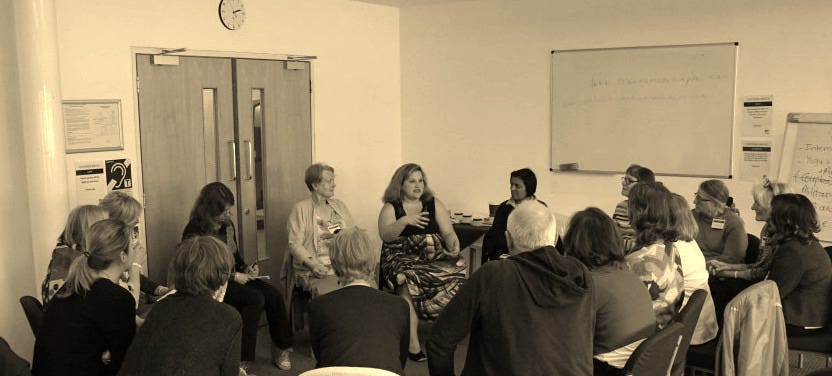
When people approach me for advice on how to get better at working with dissociation in clinical settings, they typically ask about what they should be reading or what trainings they should be taking. As both an author and a trainer myself, I am not here to disparage reading or training. Yet as I’ve written before, I believe that the modern day training market in the helping professions is out of control. It can be difficult to navigate which training might deeply serve your ongoing development, and which ones you feel pressured into taking because the marketing around the training nudged at your “pain points” about not being a skilled enough therapist.
When I have these conversations, it’s clear to me that the person asking the question might be best served by quality consultation, specifically around the case or cases that might be stumping them. The term consultation is now widely used in various trauma therapy modalities like EMDR Therapy and Brainspotting, particularly because consultation is a required part of the initial training and ongoing certification processes. Yet consultation is not a modern invention of the therapy training-industrial complex, so it is worth taking a look at what consultation means and can do at its core.
I adore looking at word origins. If you’ve read my work before, you know that etymology is always the first place that I look! The English word consult comes from a 16th century French word consulter, meaning to advise, consider, and take advice from. As a Romance language the French traces back further to Latin, with consultāre meaning to “advise repeatedly.” As therapists, we are trained not to give direct advice to the people we serve. Yet in a consultation relationship, it is expected that the person (typically another professional but not always) is hiring us for our advice.
Advice can be a bit of a loaded word. I approach being a consultant as the process of someone hiring me to share my experience, both lived and learned, on a case or other matter at hand. What I value about consultation over training is that I am able to uniquely tailor what I am sharing to the person or group of people who are enlisting my services. This means that I am better able to answer their questions with greater nuance and sensitivity to their learning styles. And I am able to offer more specific insight on a case or a clinical issue that they may be struggling with in a way that time prohibits in a general, large scale training.
In developing dissociation competency I strongly believe that consultation can be more valuable than training. One of my fervent beliefs about working with dissociative minds is that we refuse to be put into any kind of box. Although the models and techniques that you train in may give you a good set of tools and ideas, really getting good at working with dissociation requires you to get to know the mind (and heart and soul) of the person or system with whom you are working. And that means understanding that they might outright reject or resent you trying to get your favorite model or technique to work for them, instead of working with them to build a treatment approach that serves their needs. Consultation teaches you how to do this in a way that training rarely can. I see this every day as a consultant myself, and I’ve experienced it many times over the years as a recipient of my own consultation.
I still remember how valuable consultation was for me back in 2006-2007 when I treated my first therapy participant with dissociative identity disorder. Even though I’d learned a great deal about dissociation following my own diagnosis with what is now called Otherwise Specified Dissociative Disorder (OSDD) in 2004, I was in new territory here. I was a relatively young clinician, newly trained in EMDR Therapy, and I’d fought with the agency I worked at to allow me to proceed with treating the therapy participant as a person with dissociative identities. Because my superiors were trying to convince me it was anything but DID. After several weeks of working with this highly intelligent system, I started to wonder if we could make EMDR Therapy work for them? Especially because trauma existed at the root of what ailed them. I would never have been able to follow through with this internal prompting without weekly or every-other-week meetings with my primary EMDR consultant at the time. I still value those weekly check-ins of my work as the system I worked with and I waded through the sometimes treacherous waters of trauma work to figure this out for them.
I credit that early consultation experience with Don DeGraffenried, who I sought out because of his specialty in community mental health, with building my confidence in working not just with dissociative disorders, but with all sorts of more complicated cases. The one-on-one work that I was able to do with Don was more beneficial than any training I could have taken at that point in my career, because the consultation was helping me tailor what I knew and was learning to the specific person I was serving. And I ended up learning a great deal about myself and my capacity as a developing therapist in the process. Although I consulted more frequently in those early days of my career, I will still book consultation with people whose expertise and experience in a given area that I might be facing is more vast than my own. For me, spending my money on consultation usually feels more valuable than spending money on training.
I realize that the position I take in this piece has some inherent problems. Consultation is a privilege for many therapists to be able to access. For those who are pursuing an advanced certification in something like EMDR Therapy, it is an expense for which they have to budget. And many do not pursue the advanced certification because it is cost prohibitive. It is unlikely that consultation can count for formal continuing education in the eyes of the many accrediting bodies and licensing boards that we have to navigate. This is a sad reality that I hope can change in the future because consultation exists as some of the most powerful “continuing education” that we have available. Although different from supervision because no legal or licensing body relationship is implied, at least here in the United States, consultation serves a similar purpose. Consultation allows a person to be mentored and guided by someone who has a wealth of experience, strength, and hope to share. And I cannot think of many forms of education that are better than that, especially for adult learners.
Going forward, I hope that those of us who are in positions to consult will continue to make it more available and accessible for people who do find the costs to be a barrier, or who see spending money on the official “CEUs” as more necessary. Offering group consultations, which we often do in the EMDR Therapy world, at lower rates is one option, as is offering a sliding scale or something similar to potential consultees if you are able. When you are a new consultant, someone we call a “consultant in training” in the EMDR Therapy world, I see committing to lower rates as a necessary service.
As I previously announced, I am selling The Institute for Creative Mindfulness, my EMDR Therapy training company, at the beginning of 2027 and am embarking on a variety of career transitions. Although I will still offer some formal CEU-eligible training going forward, I am planning to place the bulk of my teaching energy into offering more consultation, both individual and in the group setting. With the restrictions that so many continuing education regulators put on the validity of lived experience and other forms of inquiry that exist outside of peer-reviewed journals, I’ve come to learn that my passion for teaching is best shared in the consultation setting. I enjoy helping people who come to me figure things out, giving them the extra encouragement that training or reading might not be able to give. And this consultation forum is where I can truly practice one of my deep commitments as an educator: to meet people where they are at with their learning needs and desires for future growth.
To read more about the areas in which I consult, go to:
https://jamiemarich.com/consultant/
I add in consultation groups and individual times slots every three months. For the latest listing of offerings through the Summer of 2026, please visit: www.calendly.com/jamie-marich
I wholeheartedly agree.
I get so much out of consultation! I look forward to it and I’ve processed some of my most challenging cases this way since getting EMDR trained